
On-Page SEO Optimisation: A Complete Guide for 2026
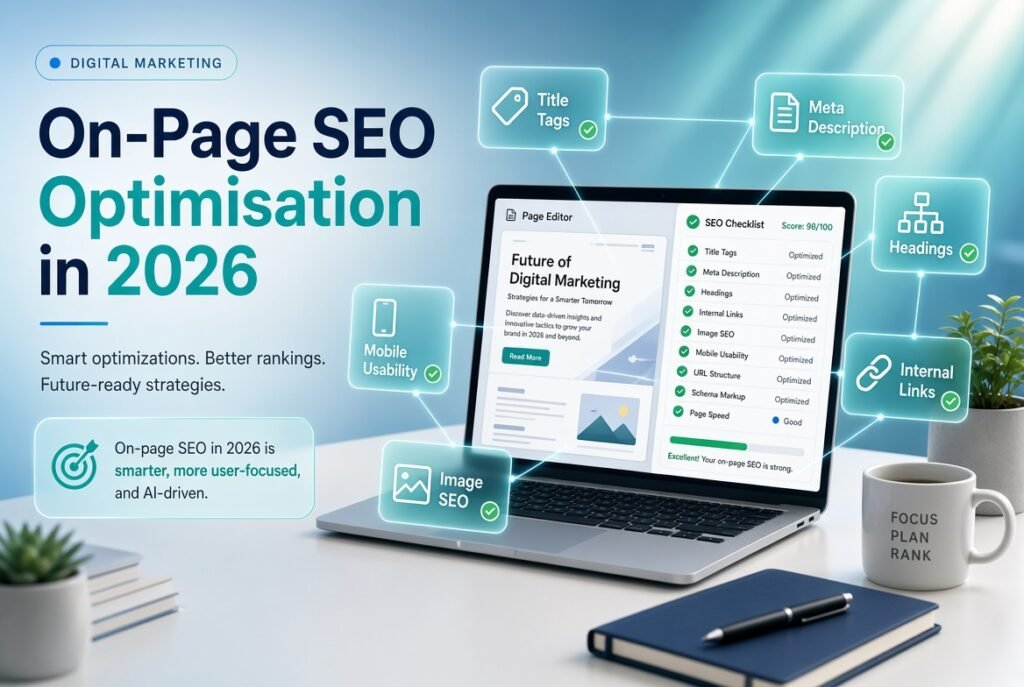
On-Page SEO Optimisation: How to Improve Your Website in 2026
1. Who This Article Is For
This article is for website owners, bloggers, business owners, digital marketers, and SEO professionals who want to improve their website’s visibility in search engines. If your website struggles to attract organic traffic, your pages are not ranking for relevant keywords, or visitors leave without taking action, learning about on-page SEO optimisation can help you identify practical ways to improve your content and website experience.
2. Introduction
Have you ever published a new page on your website, added relevant content, and waited for Google to rank it, only to see little or no improvement? This can be frustrating, especially when you have invested time and effort into creating something useful.
One factor worth reviewing is your on-page SEO.
On-page SEO optimisation involves improving the elements of individual web pages so search engines can better understand their content and visitors can navigate them more easily. This includes page titles, headings, written content, internal links, images, and other elements that influence how a page communicates its purpose.
In today’s competitive digital environment, simply adding keywords to a page is not enough. Your content needs to answer the searcher’s question, provide useful information, and offer a positive browsing experience.
For businesses working to improve their online presence, practical on-page optimisation is an important part of a broader SEO strategy. When your pages are clear, relevant, and well organised, you make it easier for both users and search engines to understand what your website offers.
The good news is that you can improve many on-page SEO elements without advanced coding knowledge. With a structured approach, you can start making meaningful improvements to your website.
3. What Does On-Page SEO Optimisation Involve?
On-page SEO optimisation is the process of improving the content and HTML elements of a web page to make it more relevant, understandable, and useful.
It focuses on elements you can control directly on your website, rather than external signals such as backlinks from other websites.
Common on-page SEO elements include:
- Title tags: The titles that can appear as clickable links in search results.
- Meta descriptions: Short summaries that may appear below search result titles.
- Headings: H1, H2, and H3 headings that organise content into clear sections.
- Page content: Relevant, accurate information that answers visitors’ questions.
- URL structure: Clear, descriptive addresses that reflect the page’s topic.
- Internal links: Links connecting related pages within your website.
- Image optimisation: Descriptive file names, suitable image formats, and helpful alternative text where appropriate.
- User experience: Readability, navigation, mobile usability, and page performance.
These elements work together to help communicate a page’s purpose. However, optimising them does not guarantee higher rankings, because search performance also depends on competition, content quality, technical factors, and other signals.
4. When Should You Review Your On-Page SEO?
Some on-page SEO problems are easy to overlook. A page might look attractive to visitors but still lack clear headings, useful descriptions, or a logical structure.
Here are some signs that your website may benefit from an on-page SEO review:
- Your important pages receive impressions but very few clicks.
- Your content does not clearly answer the questions visitors are searching for.
- Several pages target the same topic without offering distinct value.
- Your page titles are vague, duplicated, or unnecessarily long.
- Your content is difficult to scan because it contains large blocks of text.
- Your internal links do not help visitors discover related information.
- Your images are unnecessarily large or lack meaningful alternative text.
- Your pages are difficult to use on mobile devices.
- Visitors struggle to find important information or complete an intended action.
These issues can have different causes. For example, a low click-through rate may relate to search intent, competition, the search result layout, or the title and description shown in search results.
Reviewing your on-page SEO helps you identify opportunities for improvement without assuming that every performance issue has the same solution.
5. The Most Important Elements of On-Page SEO Optimisation
Title Tag Optimisation
The title tag is an important element because it helps describe a page’s main topic. Google may use it when generating the clickable title displayed in search results, although the displayed title can differ from the one you provide.
A useful title should be descriptive, relevant, and easy to understand.
For example:
Weak title: Home | Website
Improved title: Affordable WordPress Website Design Services
The improved version communicates the page’s purpose more clearly.
When writing title tags:
- Include the main topic naturally.
- Make each important page title distinct.
- Describe the page accurately.
- Avoid unnecessary keyword repetition.
- Keep the title concise enough to communicate its meaning clearly.
There is no guaranteed character limit that prevents Google from rewriting or truncating a title. Focus on clarity rather than trying to meet an exact character count.
Meta Description Optimisation
A meta description summarises the content of a page. Google may use it in search results, but it can also generate a different snippet from the page’s content.
Although meta descriptions are not a direct Google ranking factor, a clear and relevant description may help users understand why a page is worth visiting.
For example:
Instead of writing, “Welcome to our website. We provide quality services”, describe what the page actually offers and who it helps.
A useful meta description should:
- Summarise the page accurately.
- Include relevant wording naturally.
- Explain the value visitors can expect.
- Avoid misleading promises.
- Be unique for important pages.
Treat the meta description as a concise introduction to the page rather than a place to repeat keywords.
Heading Structure and Content Organisation
Headings make your content easier to navigate and help readers understand the relationship between different sections.
Use one clear main heading for the page’s primary topic, followed by relevant subheadings that organise the content logically.
For example, an article about on-page SEO might include sections covering title tags, headings, image optimisation, internal linking, and content quality.
A logical heading structure helps people scan long articles and find the information they need.
You do not need to force keywords into every heading. Use descriptive wording that reflects the actual content of each section.
High-Quality Content Optimisation
Content is central to effective on-page SEO.
A page should answer the searcher’s question with accurate, relevant, and sufficiently detailed information. It should also provide something useful rather than repeating the same points found across competing pages.
Before publishing, consider whether your content:
- Answers the main search query early.
- Covers the topic at an appropriate level of detail.
- Uses clear language and practical examples.
- Includes trustworthy information.
- Avoids unnecessary repetition.
- Reflects your experience or genuine understanding of the subject.
There is no universal word count that guarantees rankings. A short page can be effective when it fully answers a simple question, while a complex topic may require a more detailed explanation.
Prioritise usefulness over length.
Keyword Placement and Relevance
Keywords help describe the topic of your page, but they should be used naturally.
Your primary keyword may appear in the title, main heading, introduction, URL, or relevant subheadings where appropriate. Related terms can also help you cover the subject comprehensively.
For example, an article targeting “on-page SEO optimisation” might naturally discuss content optimisation, internal linking, title tags, and image SEO.
Avoid repeating the same phrase excessively simply because you believe it will improve rankings. Keyword stuffing can make content difficult to read and may violate Google’s spam policies.
The goal is to create content that clearly addresses the topic and satisfies the user’s needs.
URL Structure
A clear URL helps users understand what a page is about before visiting it.
For example:
Less descriptive: example.com/page?id=123
More descriptive: example.com/on-page-seo-optimisation
When creating URLs, use meaningful words, keep them reasonably concise, and separate words with hyphens.
Avoid changing established URLs without a clear reason. If you do change a URL, implement an appropriate permanent redirect and update relevant internal links to reduce disruption.
Internal Linking
Internal links connect one page of your website to another.
They help visitors discover related content and provide search engines with pathways to explore your website.
For example, an article about on-page SEO could link to relevant guides about keyword research, technical SEO, content optimisation, and SEO audits.
Effective internal linking involves:
- Linking to pages that genuinely support the reader.
- Using descriptive anchor text.
- Connecting related pages naturally.
- Helping visitors find important service or product pages.
- Avoiding excessive links that distract from the content.
A thoughtful internal linking structure can improve navigation and help search engines understand how your content relates to other pages.
Image SEO Optimisation
Images can improve understanding, demonstrate products, and make content more engaging. However, poorly prepared images may affect page performance or accessibility.
To optimise images:
- Choose suitable image formats and dimensions.
- Compress files without unnecessarily reducing quality.
- Use descriptive file names where practical.
- Write meaningful alt text for informative images.
- Leave decorative images with an empty alt attribute when appropriate.
- Ensure images display correctly on different screen sizes.
Alt text should describe the purpose or relevant content of an image, not serve as a list of keywords.
Image optimisation should support both accessibility and user experience rather than being treated as a keyword-placement exercise.
Mobile Usability and Page Experience
Many visitors access websites using mobile devices, so your pages should remain easy to read and navigate on smaller screens.
Check whether text is readable, buttons are easy to use, menus work correctly, and important information is visible without unnecessary effort.
Page performance also matters to the browsing experience. Large images, unnecessary scripts, and poorly configured page elements may contribute to slow loading.
Google uses Core Web Vitals as part of its broader page experience considerations. These metrics measure loading performance, responsiveness, and visual stability.
Good page experience is valuable for users, but meeting every performance threshold does not guarantee higher rankings.
6. The Connection Between On-Page SEO and User Experience
On-page SEO and user experience are closely related because both focus on helping visitors understand and use your website.
When someone arrives on a page, they want to know whether it answers their question. If the heading is unclear, the introduction is irrelevant, or the content is difficult to navigate, they may struggle to find what they need.
A well-organised page makes the experience easier.
Clear headings help visitors scan the content. Relevant internal links guide them to further information. Readable paragraphs reduce effort, while accessible images and mobile-friendly layouts make the page more usable.
It is also important to understand that user behaviour is not a simple ranking formula. A visitor leaving a page quickly does not automatically mean the page is poor, particularly if they found the answer they needed.
Instead of trying to manipulate engagement metrics, focus on creating pages that fulfil their purpose and provide a satisfying experience.
This approach supports both practical usability and a more sustainable SEO strategy.
7. How Poor On-Page SEO Can Affect Your Website
Weak on-page optimisation can make it harder for visitors and search engines to understand your website.
For example, vague page titles may fail to communicate what a page offers. Poor content organisation can make important information difficult to find. Missing or irrelevant internal links may prevent visitors from discovering useful related pages.
For business websites, these problems can affect how effectively your pages communicate your services and guide potential customers.
For blogs, they may make it harder for readers to navigate articles or find answers to related questions.
However, on-page SEO is only one part of overall website performance. Low rankings or limited conversions may also relate to technical problems, competition, insufficient content relevance, website credibility, pricing, or the quality of the offer.
A useful audit examines these factors together rather than assuming that changing a title tag will solve every problem.
8. Practical Steps to Improve Your On-Page SEO
You can start improving your website by following a consistent optimisation process.
Step 1: Choose an Important Page
Begin with a page that matters to your business or already receives some search impressions.
This could be a service page, a product page, or an informative blog article.
Step 2: Identify the Main Search Intent
Understand what people are likely trying to find when searching for your target keyword.
Review relevant search results and determine whether the page should provide information, compare options, describe a service, or support a purchase.
Step 3: Review the Title and Main Heading
Ensure that your title tag and H1 heading accurately describe the page.
They should communicate the topic clearly without misleading visitors or forcing unnatural keyword repetition.
Step 4: Improve the Content
Check whether the page answers the main question, explains important details, and offers useful information.
Remove unnecessary repetition and add practical examples or missing explanations where they improve the reader’s understanding.
Step 5: Improve Internal Links
Identify relevant pages that would help visitors explore the topic further.
Add natural internal links with clear anchor text and check that important pages are not unnecessarily difficult to reach.
Step 6: Check Images and Mobile Usability
Review image sizes, alternative text, layout, readability, and navigation.
Test the page on a mobile device to identify problems that might not be obvious on a desktop computer.
Step 7: Review Performance Data
Use Google Search Console to review impressions, clicks, queries, and average positions.
Where appropriate, use an analytics platform to assess relevant engagement and conversions.
Compare performance over time and consider other factors that may affect results, including competition, seasonality, and search demand.
Step 8: Keep Improving
SEO is not a one-time activity. Revisit important pages when information becomes outdated, search intent changes, or performance data reveals an opportunity to improve.
Make changes thoughtfully and allow enough time to assess their effects. Avoid changing multiple elements repeatedly without a clear reason.
9. When Should You Invest in On-Page SEO Optimisation?
On-page SEO optimisation is useful throughout the life of a website.
Consider reviewing your pages when:
- You launch a new website or publish new content.
- You add products or services to an existing website.
- Your important pages receive fewer clicks than expected.
- Your content no longer reflects current information.
- You notice overlapping topics across multiple pages.
- You redesign your website or change its navigation.
- You want to improve the search visibility of existing content.
- You are preparing a broader SEO audit.
Regular reviews help you identify problems before they become harder to manage.
You do not need to optimise every page simultaneously. Start with pages that have clear business value, meaningful search demand, or obvious opportunities for improvement.
10. Strengthen Your Website with Md Aminur Islam
Improving your website’s search visibility requires a combination of relevant content, thoughtful optimisation, and a clear understanding of your audience.
At mdaminurislam.com, you can explore information about SEO and digital marketing services that may help support your online growth goals.
Whether you run a business website, an e-commerce store, or a content-focused blog, on-page SEO can help you present your information more clearly and make your pages more useful to visitors.
A practical strategy begins with understanding the purpose of each page, identifying relevant search intent, and improving the elements that genuinely help users.
With consistent effort and performance monitoring, on-page optimisation can become a valuable part of your long-term digital marketing approach.
11. Frequently Asked Questions About On-Page SEO Optimisation
1. What is on-page SEO optimisation?
On-page SEO optimisation is the process of improving individual web pages to make their content clearer, more relevant, and easier to use. It includes title tags, headings, content quality, internal links, image optimisation, and other page-level elements.
2. Why is on-page SEO important for Google rankings?
On-page SEO helps search engines understand the topic and relevance of your content. It can support better search visibility when combined with useful content, appropriate technical foundations, and other factors that influence rankings. No single optimisation guarantees a particular position.
3. What are the most important on-page SEO factors?
Important elements include helpful content, descriptive title tags, clear headings, relevant internal links, accessible images, useful page URLs, and good mobile usability. Their relative importance depends on the page, its purpose, and the competition.
4. How often should I optimise my website pages?
Review important pages periodically and whenever you notice meaningful performance changes, outdated information, or new opportunities. There is no universal schedule. The appropriate frequency depends on your industry, website size, and how quickly your content changes.
5. Is on-page SEO different from technical SEO?
Yes. On-page SEO generally focuses on page-level content and elements such as headings, titles, and internal links. Technical SEO focuses more on areas such as crawling, indexing, site architecture, and technical performance. The two areas overlap and work together.
6. Can I do on-page SEO without coding?
Yes. Many on-page SEO tasks can be completed using content management systems such as WordPress and SEO plugins such as Yoast SEO or Rank Math. More advanced technical changes may require developer support, depending on your website and the issue.
7. How long does on-page SEO take to show results?
There is no fixed timeline. Results depend on competition, website history, crawling and indexing, content quality, and the changes made. Some improvements may be reflected relatively quickly, while meaningful ranking changes can take weeks or months.
8. Does keyword density still matter in on-page SEO?
There is no ideal keyword density that guarantees better rankings. Use relevant terms naturally and focus on answering the searcher’s question. Repeating keywords excessively can make content less readable and may be considered keyword stuffing.
12. Author Section
Written by Md Aminur Islam — Digital Marketing Consultant and Growth Strategist.
Md Aminur Islam works across SEO, Google Ads, paid social, and digital growth strategy. His website highlights his work in helping businesses improve their online visibility through search engine optimisation and digital marketing.
Learn more at mdaminurislam.com.
Final Takeaway
On-page SEO optimisation is about making every important page clear, relevant, accessible, and useful. By improving titles, headings, content, internal links, images, and mobile usability, you can build a stronger foundation for your broader SEO strategy. Focus on helping visitors first, monitor performance consistently, and make improvements based on evidence rather than assumptions.