
How to Create Digital Products That People Want to Buy
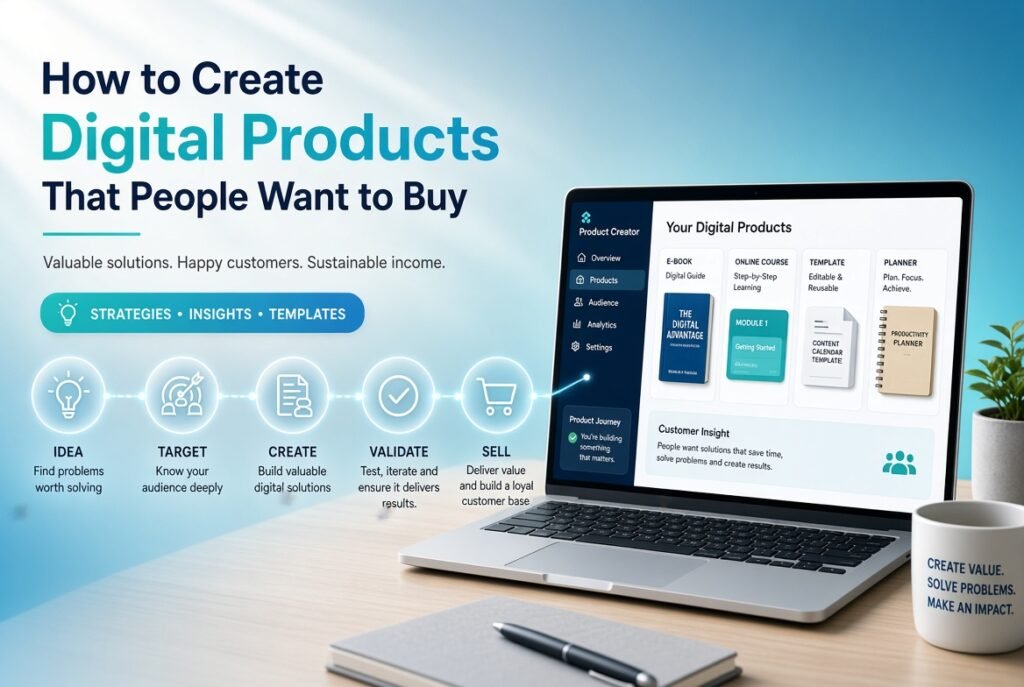
How to Create Digital Products That People Want to Buy
1. Who This Article Is For
This article is for beginners, freelancers, content creators, and online entrepreneurs who want to create digital products that customers genuinely need. If you want to sell e-books, online courses, website templates, digital planners, or other downloadable resources, this guide will help you understand how to identify customer demand, develop a useful product, and build a digital product business around real customer needs.
2. Introduction
Creating a digital product has never been more accessible. You can use affordable tools to design an e-book, build a website template, develop an online course, or create a practical resource that helps people solve everyday problems.
However, creating a product and selling it successfully are two different things.
Many beginners spend weeks developing a product before discovering that their target audience does not need it, cannot understand its value, or prefers another solution. This can be frustrating, particularly when you have invested considerable time and effort.
The solution is to start with the customer rather than the product. Instead of asking what you can create, consider what people are struggling with and what they would find useful enough to purchase.
For anyone building an online business, understanding customer demand is an essential first step. A thoughtful approach to product research, testing, and improvement can help you create digital products with a clearer purpose and a stronger chance of attracting buyers.
3. What Makes a Digital Product Worth Buying?
A digital product is worth buying when it provides a clear benefit that customers value. It might save time, simplify a task, teach a useful skill, or help someone achieve a particular goal.
Customers are not necessarily looking for the product with the most features. They want a solution that meets their needs, is easy to use, and offers reasonable value for its price.
Popular digital product formats include:
- E-books and practical guides: Resources that explain a topic or help customers complete a specific task.
- Online courses: Structured lessons that teach skills such as website design, photography, or digital marketing.
- Website templates: Ready-made layouts for WordPress, Elementor, and other website-building platforms.
- Digital planners: Calendars, productivity tools, budget trackers, and organisational resources.
- Design assets: Graphics, icons, presentation templates, and other creative materials.
- Business resources: Spreadsheets, checklists, proposal templates, and workflow documents.
- Software and plugins: Digital tools that address specific technical or business needs.
- Downloadable educational resources: Worksheets, learning materials, and reference guides.
The best format depends on the problem you want to solve and how your audience prefers to receive the solution.
For example, a small business owner who struggles to organise customer enquiries might value a simple tracking spreadsheet more than a lengthy business management e-book.
The important question is whether your product makes something easier, clearer, faster, or more achievable for the people you want to serve.
4. When a Digital Product Idea May Not Attract Buyers
Not every digital product idea becomes a successful business. Recognising potential problems before investing heavily can save time and money.
Your product may struggle to attract customers if:
- You create it based only on your personal interests.
- You have not researched your target audience.
- Similar products already exist and your offer has no clear point of difference.
- Your product does not solve a specific problem.
- The product description does not explain its benefits.
- The price does not match the perceived value.
- Your product is difficult to use or poorly presented.
- You depend on publishing the product without actively marketing it.
For example, creating a generic social media template pack may not be enough to stand out in a competitive market.
You could instead explore a more specific audience, such as local service businesses that need ready-to-edit promotional templates. This gives you a clearer group of potential customers and a more focused problem to solve.
Competition alone does not mean an idea is unsuitable. Existing competitors can indicate that customers already purchase solutions in that category. Your task is to understand what customers like, what they find frustrating, and where your product could offer something useful.
5. How to Create Digital Products That People Want to Buy
Start with a Real Customer Problem
The first step is identifying a problem that people genuinely want to solve.
Think about the questions customers repeatedly ask, tasks they find difficult, or activities that take too much of their time. You can discover these problems through online communities, customer reviews, forums, search results, and conversations with potential buyers.
For example, small business owners may struggle to create professional proposals. Freelancers may need a better way to track projects. New WordPress users may want simple instructions for building their first website.
Each problem could inspire a digital product, but you should research whether people want a paid solution before developing it.
A useful starting question is: What is one specific task I can help someone complete more easily?
Research Your Target Audience
Once you identify a problem, learn more about the people experiencing it.
Consider their skill level, goals, budget, existing solutions, and reasons for looking for help.
You can use keyword research tools to explore what people search for online. Competitor reviews can also reveal recurring complaints, missing features, and opportunities to improve the customer experience.
If possible, speak directly with potential buyers. Ask open questions about their current challenges rather than simply asking whether they like your idea.
People may express interest in a product without actually purchasing it. Real buying behaviour provides stronger evidence than positive comments alone.
Study Competing Products
Competitor research helps you understand the market before creating your own offer.
Look at products serving a similar audience and examine their features, presentation, pricing, customer feedback, and limitations.
Pay attention to comments that mention confusing instructions, missing features, poor usability, or difficulties applying the product in real situations.
Use these insights to identify ways to create a more useful experience. Do not copy competitors’ protected content, designs, branding, or intellectual property.
Your goal is to learn what customers value and develop an original product that meets their needs.
Choose the Right Product Format
A good idea can become less effective if you present it in a format that does not suit the customer.
For example, a checklist may be more useful than a video course when customers need a quick reference. A structured course may be appropriate when they need to learn a skill through multiple lessons.
Consider the complexity of the problem, how customers will use the product, and what you can realistically create.
Choose a format that delivers the intended benefit without adding unnecessary complexity.
Create a Useful First Version
You do not need to create a large product catalogue before testing your idea.
Start with a focused version that solves one important problem. This might be a short guide, a small collection of templates, a practical spreadsheet, or a clearly organised introductory course.
Make sure the product is accurate, easy to understand, and functional. If you use AI tools during development, review the output carefully for errors, originality, and quality.
Also check that you have the necessary commercial rights for any fonts, images, graphics, software, or other resources included in the product.
Test the Product Before a Full Launch
Before investing heavily in marketing, share a sample or early version with a small group of relevant users.
Ask them to complete a realistic task using the product. Find out what was helpful, what was confusing, and what they would change.
Where appropriate, test a paid offer with potential customers. Actual purchases can provide stronger evidence of demand than survey responses or social media engagement alone.
Use the feedback to improve the product before expanding its features or creating additional versions.
Make the Product Easy to Understand and Use
Customers should be able to understand what they are purchasing and how it will help them.
Use clear instructions, organised content, readable formatting, and a logical structure. Include demonstrations or examples when they help explain the product.
Your product page should clearly communicate:
- Who the product is designed for.
- What problem it addresses.
- What is included in the purchase.
- How customers will access or use it.
- Any requirements, limitations, or compatibility details.
- The applicable price and refund terms.
Clear information helps customers make informed decisions and can reduce misunderstandings after purchase.
6. The Connection Between Customer Psychology and Buying Decisions
People do not purchase digital products simply because they exist. They usually buy because they believe a product can help them achieve something they value.
Understanding this decision-making process can help you communicate your offer more effectively.
Customers Want Clear Benefits
A product description that lists features may not explain why someone should care.
For example, saying that a template pack contains 30 layouts describes what is included. Explaining that the layouts help small businesses prepare consistent promotional materials more efficiently communicates the intended benefit.
Describe the genuine advantages of your product without exaggerating what it can achieve.
Trust Influences Purchasing Decisions
Customers may hesitate if they do not understand the product or feel uncertain about the seller.
Clear demonstrations, realistic previews, transparent pricing, accurate descriptions, and genuine customer feedback can help build confidence.
If you are launching your first product, you can build trust by showing how it works and explaining exactly what buyers will receive.
Never invent testimonials, sales figures, or customer results.
Simplicity Can Improve the Customer Experience
A product with too many unnecessary features may overwhelm users.
Consider what customers need to accomplish and remove anything that makes the process more complicated without adding meaningful value.
A well-organised, practical resource can be more useful than a product that appears impressive but is difficult to apply.
The Price Should Match the Perceived Value
Customers compare a product’s price with its expected benefits and available alternatives.
A higher price may be reasonable when a product offers specialised knowledge, substantial practical value, or meaningful support. A simple resource may require a more accessible price.
Research your market and consider your product’s quality, audience, and costs before setting a price. Avoid relying on artificial discounts or misleading claims to encourage purchases.
7. How Digital Product Creation Affects Your Time and Business
Creating digital products can provide an opportunity to turn your skills and knowledge into something that can be sold repeatedly.
For example, a website designer could develop Elementor templates based on common customer needs. A teacher could create original learning resources, while a business professional could develop useful spreadsheets or workflow guides.
However, product creation still requires research, planning, development, testing, and marketing.
After launch, you may need to answer customer questions, fix errors, update information, and adapt the product as customer needs change.
Your workload depends on the product format and the level of support you provide.
It is also important to manage your expectations. A product that is available for purchase around the clock will not necessarily generate regular sales. You still need to reach potential customers and communicate why your offer is useful.
Start with a manageable project and give yourself enough time to evaluate customer feedback before making major investments.
8. Practical Steps to Develop and Sell Your First Digital Product
Step 1: Select a Specific Audience
Choose a group of people whose needs you understand or are willing to research.
Examples include freelancers, students, small business owners, website designers, or content creators.
A clearly defined audience helps you focus your research and create a product that addresses a relevant problem.
Step 2: Validate the Problem
Investigate whether your audience actively experiences the problem you want to solve.
Read customer discussions, review competing products, research relevant search terms, and speak with potential buyers.
Look for evidence that people are already spending time or money trying to solve the problem.
Step 3: Define Your Product’s Main Benefit
Write one simple sentence explaining what your product helps customers accomplish.
For example: “This website launch checklist helps beginner WordPress users organise the essential steps before publishing a website.”
A clear benefit can guide your product development and marketing.
Step 4: Develop a Small, High-Quality Product
Create the minimum set of resources needed to deliver the promised benefit.
Avoid adding features simply to make the product appear larger. Focus on usability, accuracy, clear instructions, and a professional presentation.
Step 5: Test It with Real Users
Invite relevant people to try the product and provide honest feedback.
Observe whether they can use it successfully and identify any confusing sections or missing information.
Where appropriate, test whether potential buyers are willing to pay before investing in a more extensive version.
Step 6: Set Your Price
Research comparable products and calculate your expected expenses.
Consider production time, platform fees, payment processing, marketing costs, customer support, and any applicable taxes.
Choose a price that makes sense for your target audience and business model while reflecting the product’s genuine value.
Step 7: Build a Product Page
Create a clear page explaining the problem, the solution, the product contents, and the purchasing process.
Include relevant screenshots, previews, examples, and compatibility information where appropriate.
You can sell through a suitable marketplace or your own website. For WordPress users, WooCommerce can support eligible downloadable products and automated delivery.
Step 8: Promote the Product to the Right Audience
Use marketing channels that fit your customers.
SEO-friendly blog posts can attract people searching for solutions. Social media can demonstrate the product, while email marketing can help you communicate with subscribers who have agreed to receive your messages.
Focus on useful content and clear product benefits rather than relying only on promotional posts.
Step 9: Measure Results and Improve
Track relevant information such as website traffic, sales, conversion rates, refunds, and customer feedback.
If people visit your product page but do not purchase, review the clarity of your offer, pricing, trust signals, and audience targeting.
If customers purchase but struggle to use the product, improve the instructions or product design.
Use these observations to make targeted changes rather than assuming that every problem requires a completely new product.
9. When to Seek Professional Guidance
Professional guidance may be useful if you are struggling to identify customer demand, choose a product format, price your offer, or develop a marketing strategy.
A relevant digital product business course can provide a structured approach to market research, product development, sales pages, and promotion.
Before purchasing a course or hiring a consultant, review their experience, the learning outcomes, the support available, and the total cost.
If you are a beginner with a limited budget, you can start by using free educational resources and testing a small product idea.
You may also need specialist advice about copyright, licensing, data privacy, consumer protection, or tax obligations, depending on your product and target market.
Be cautious of anyone promising guaranteed sales or instant profits. The purpose of learning and professional guidance should be to improve your understanding and decision-making, not to eliminate the uncertainty involved in running a business.
10. Create Better Digital Products with Md Aminur Islam
Creating digital products that people want to buy begins with understanding customers, not simply choosing a product format or following a trend.
Research a specific problem, identify your audience, develop a practical solution, and test your idea before making a large investment.
Focus on providing genuine value, communicating clearly, and improving your product based on real feedback. These steps can help you build a more informed approach to digital entrepreneurship.
For more information and resources related to digital business and online growth, visit mdaminurislam.com.
Whether you are planning your first downloadable resource or expanding an existing online business, remember that a successful product starts with a clear customer need and a solution that delivers on its promise.
11. FAQs About Creating Digital Products That People Want to Buy
How do I know what digital products people want to buy?
Research customer problems, search trends, competitor reviews, and discussions in relevant online communities. Speak with potential buyers when possible and test your idea with a sample or paid offer. Actual purchasing behaviour provides stronger evidence of demand than likes or general expressions of interest.
What digital products are easiest to create for beginners?
Simple e-books, checklists, spreadsheets, templates, and practical guides can be suitable starting points. The best option depends on your skills and the problem you want to solve. Choose a product you can create well rather than selecting one simply because it appears easy to make.
How can I validate a digital product idea before creating it?
Identify your target audience, research existing solutions, and investigate whether customers are actively trying to solve the problem. You can share a product concept, offer a sample, interview potential buyers, or test a small paid offer before investing heavily in development.
Do I need technical skills to create digital products?
Not always. Many digital products can be created using accessible design, document, spreadsheet, and presentation tools. More specialised products, such as software or advanced website templates, may require additional technical knowledge. Choose a format that matches your current abilities and resources.
How much should I charge for a digital product?
Pricing depends on the product’s value, complexity, target audience, competition, and business expenses. Research comparable offers and calculate your costs before setting a price. The goal is to choose a price that customers can understand and that supports a sustainable business model.
Can I use AI to create digital products?
AI tools can help with research, brainstorming, drafting, organisation, and some design tasks. However, you should review all output for accuracy, originality, quality, and usefulness. Check the applicable tool terms and licensing requirements, and ensure that your finished product provides genuine value rather than generic content.
How can I sell digital products without a large audience?
You can begin by reaching a specific group of potential customers through SEO, helpful content, relevant communities, partnerships, or targeted outreach where appropriate. A large audience is not always necessary, but you do need a reliable way to reach people who may benefit from your product.
Why do some digital products fail to sell?
Common reasons include weak customer demand, unclear product benefits, poor presentation, unsuitable pricing, strong competition, and insufficient marketing. Reviewing customer feedback and sales data can help identify the issue. Sometimes the best solution is to improve the offer or target a more specific audience.
12. Author Section
Written by Md Aminur Islam
Md Aminur Islam shares information and resources related to digital business, online entrepreneurship, and digital growth.
Website: https://mdaminurislam.com/